It’s a another squad-level, tactical, WW 2 game with a focus on infantry combat. I’ve played an earlier edition (‘Band of Heroes’) quite some time ago but sold it. I recently had the itch for another WW2 tactical title but was not too keen into relearning ASL.
Components
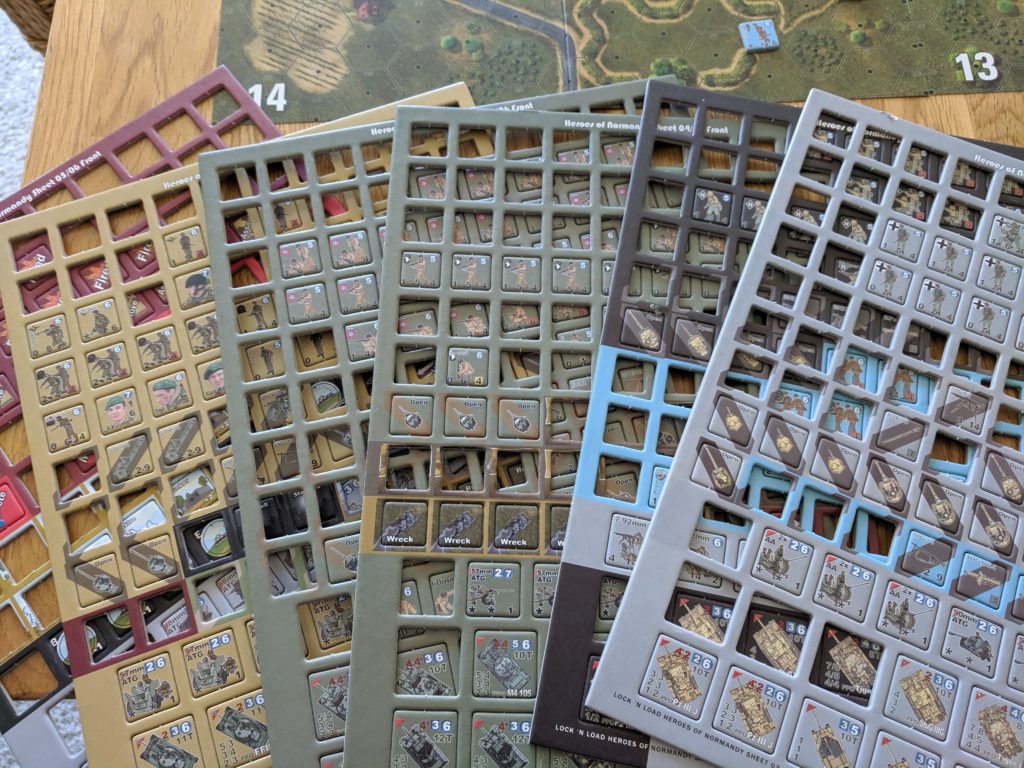
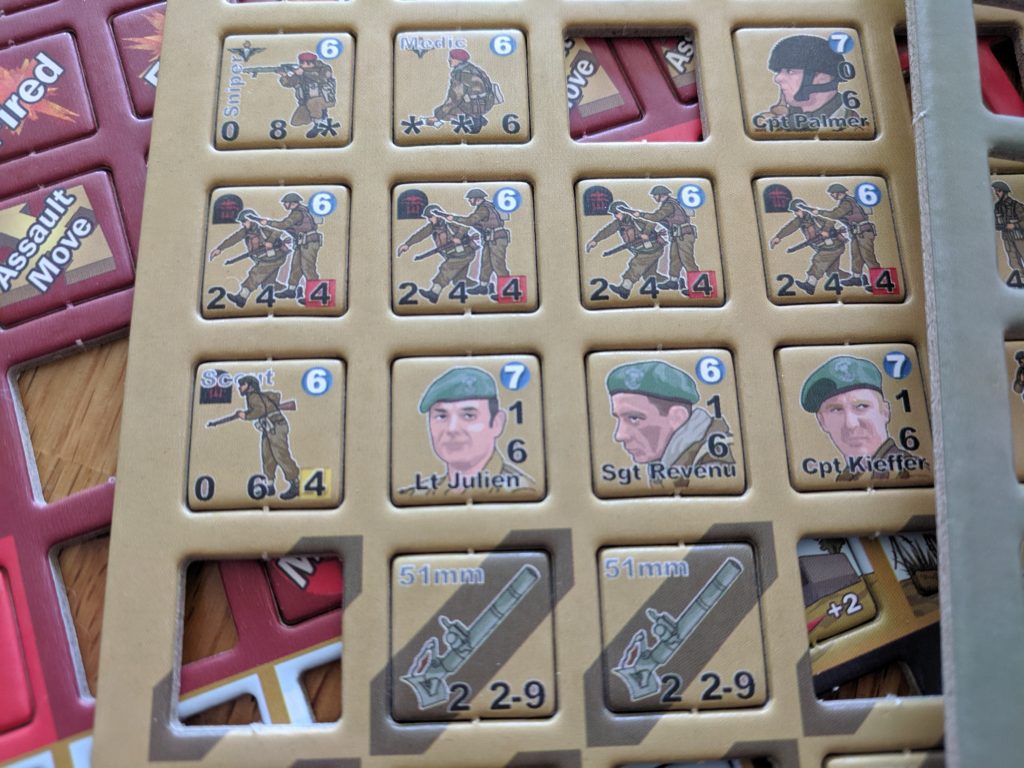
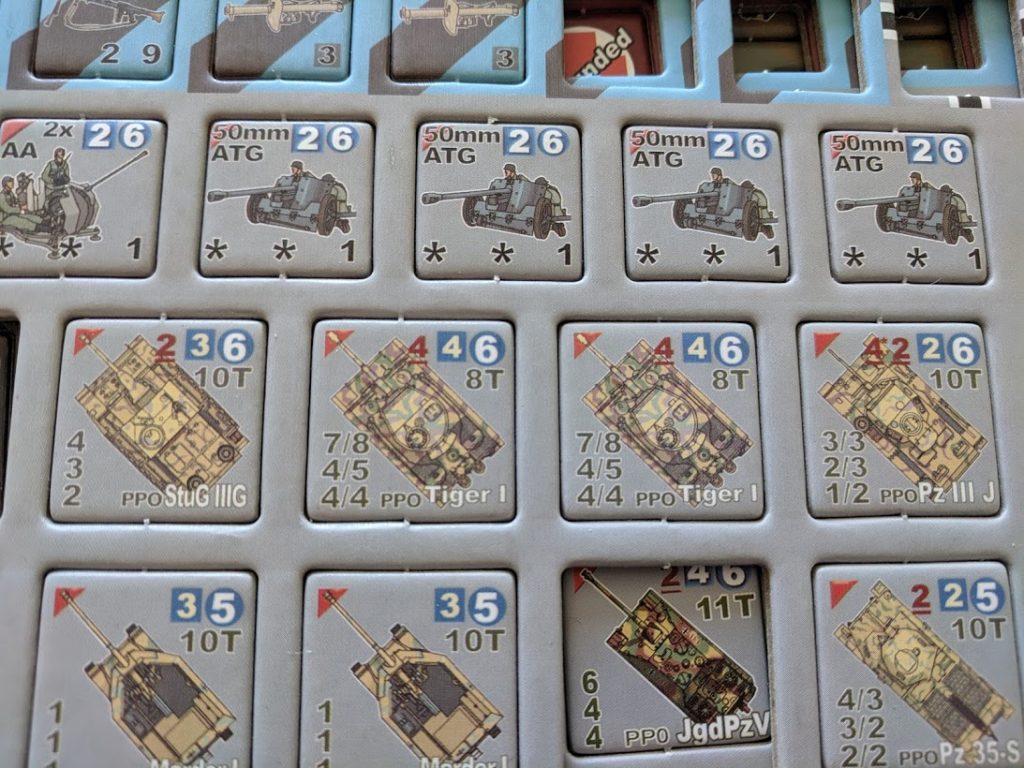
Let’s start with the good and easy stuff. The components are nice, the counters are colorful, well-graphicked, thick and come prerounded on many, many sheets. The illustrations are good but in some cases show their age — some drawings are more detailed than others, some lack shading. The box is nice and big and has enough space left to keep all punched counters as well as additions to the base game, such as extra maps.
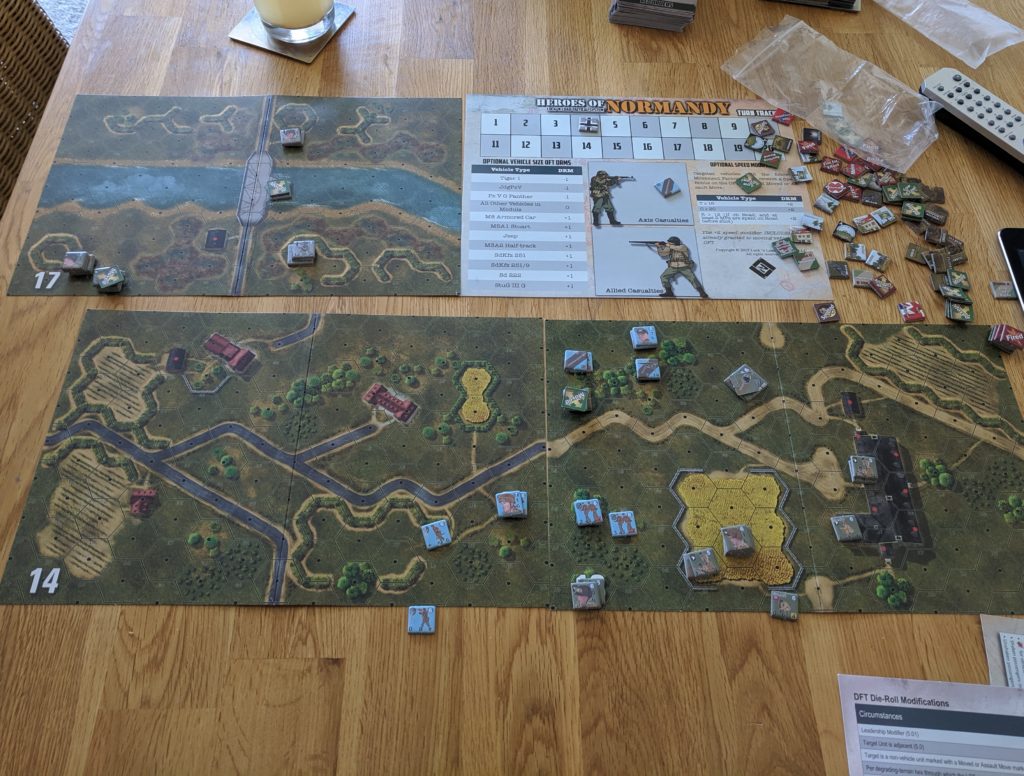
Speaking of, the maps are nice looking and with a good level of detail (but are working against the LOS rules — see below). Maps are available as standard or, for an additional fee, as double-sized x-maps. I like the small footprint of the game — two or three maps fit easily on the kitchen table which I think as an advantage that is quickly lost when using the x-maps. I use the latter only for single-map scenarios and certainly don’t think that they’re necessary or even a good purchase. Same goes for the scenario editor, but see below for my gripe with it.
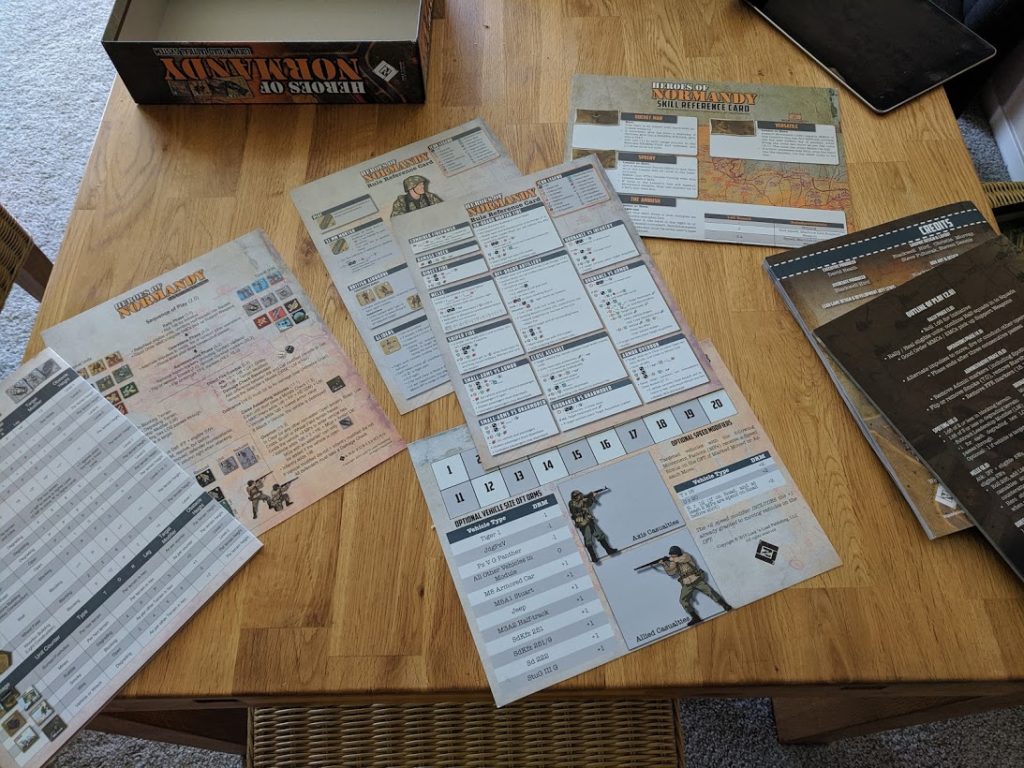
There are lots of player aid charts in the game and they are of very different quality and design. Looking at their layout and design, they feel like artifacts from different stages of the publishing process. The direct combat result procedure, for example, is present on three(!) of the charts, including the front and the back of the same chart but always in slightly different form and layout. I really would have hoped for a single layout style and to reduce the amount of repetition.
Gameplay Overview
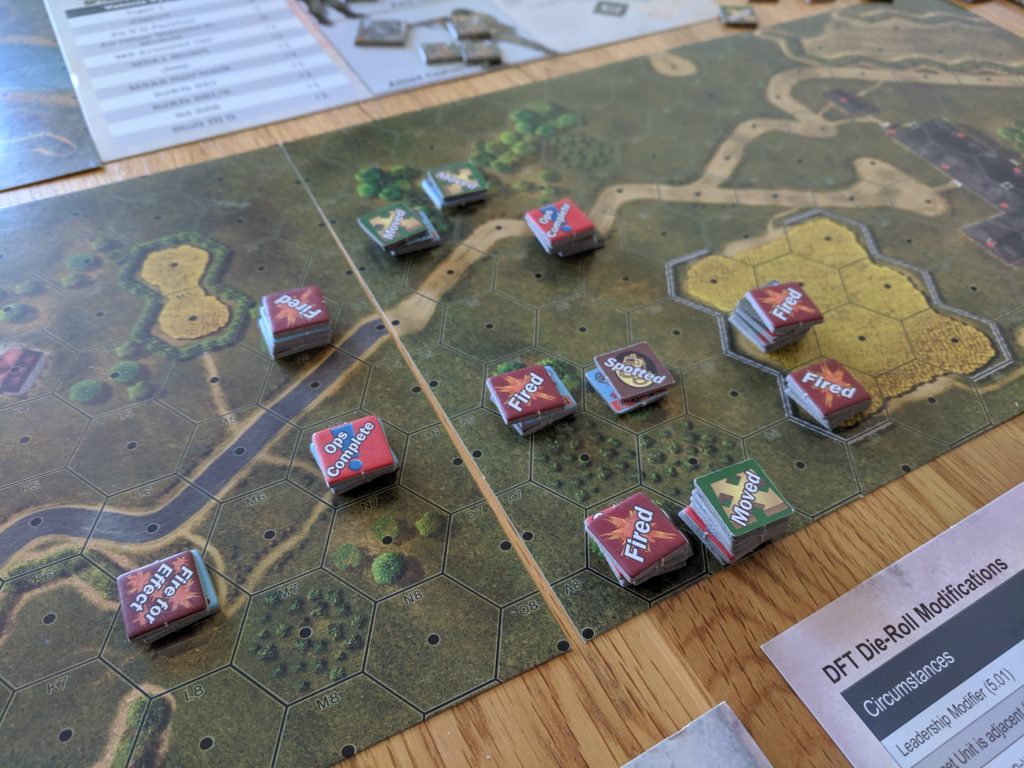
Players take turns activating hexes/stacks of units. The basic actions these units can take is either shoot or move — a very literal interpretation of the Fire & Movement concept.
Furthermore, before a unit can be targeted it must be spotted by other units. Units usually become spotted as soon as they start moving or firing. All units become unspotted at the beginning of a turn. These two rules create very dynamic and reactive scene: there are lulls in the fire combat which then starts again and builds up into a crescendo as units that are firing get fired on which in turn draws fire from other units. Overall, the effect is very neat and achieved with little rules.
The basic tactic of the game is find, fix, flank, finish. Fire combat is used to break units that then become easy prey for either further damage or close combat. So far, so standard.
Morale is handled in the same-old-unchanged-from-ASL manner: taking fire, units break and must pass a morale check before becoming good order again. There are only few leader-like figures that allow units to try to roll a morale check. Leaders therefore feel more like firemen, running from hotspot to hotspot, trying to rally the troops. Unfortunately, other forms of command and control are missing.
Heroes are created during morale checks and have randomly assigned capabilities, such as increase movement range or improved attacks when using bazookas.
Tanks and vehicles are present and are interesting. On one hand, tanks are very powerful, having multiple weapons that can fire independently are are pretty much impervious to small arms fire.
On the other hand, the claustrophobic nature of most maps mean that tanks can be ambushed easily. Infantry has a good chance to take out tanks in close combat, especially with support weapons, such as satchel charges. Some tanks are partially open (such as many tank destroyers) which means that they have no effective armor bonuses against infantry in close combat. Anti-tank guns seem also very effective in this game as tank damage is pretty much binary: either no damage at all, because the shot missed, or a deadly brew-up.
Like in ASL, tanks and guns are facing hex vertices, not hex sides. I’m not sure about the reasoning behind it, except that ASL does the same. Ordnance also relies on a to-hit procedure with a table look-up. Unfortunately, this table is printed on the backside of the counter, meaning that if you want to fire the tank’s gun, you will have to pick up the counter, squint at the tiny table, do your roll and put the counter back down to where it was. I don’t think that’s ideal, neither is that the tank counter itself is adorned with some 12 values.
Rule quibbles
The game comes with ruleset 4.2, which is well presented and easily digestable for the most part. These rules have been separated between ‘modern’ and ‘World War 2’ rule sets, which cut down on the to-ignor rules, such as Helicopters. There are still some very odd rules issues that should have been fixed by now. LOS is the prime example for this.
LOS is blocked by outlines of buildings, trees, etc. This sounds is used in other games (again ASL) but breaks down here as the ‘high quality’ graphics of the maps do not contain clear silhouettes. When is a LOS thread blocked by a tree if you can actually see individual branches? Would then LOS change if you use the X-maps, as they apparently show more detail?
Secondly, the rules become so murky around hex-edge terrain to be almost unusable. LOS is different, depending on whether it got traced through, out of, alongside or into a hex with a wall, hedges etc. Tellingly, the terrain effect chart, which should be used for quick reference, has multiple lines (plus footnotes) for each hexside terrain. It’s a mess.
Then, there are rules for LOS blocking when the hexes contain a blocking feature but are not blocking themselves … argh. I quickly ignored all that nonsense and applied common sense to LOS. I know LOS is hard but it’s also important at that scale and the rules feel underdeveloped here. This part needs some serious rules review.
There is also an abundance of different die roll procedures. Combat requires quite a bit of wristage: opposing rolls that then translate into a DRM for another table lookup … Firing big guns (ordnance) instead is lifted straight from ASL and requires two rolls. Morale check is a 2D6 vs target value, as is close combat but here the target value is determined by a force ratio … It’s all over the place and very inconsistent. I’m not asking for 2D6 roll for every action but this collection of different rolls just feels off.
However, the actual systems are fairly light on procedure and the DRMs are few and light and after some turns it just sticks and keeps chugging along with minimal reference to the rules. It never gets to the point of no rule references (such as with Academy Games’ Conflict of Heroes or GMT’s Combat Commander games) but it plays surprisingly well.
Scenarios
Most of the scenarios pit reinforced US or British paratroopers against combined-arms German forces. There are a few scenarios in which the Allied player gets some armor as well but these are rare.
Turn limits are short on most scenarios with only 6 or 7 turns until completion and to achieve success, the attacker must move and push hard. Oftentimes, the defender can take a more relaxed, reactive approach, as he controls most of the VPs from the start.
Scenarios are further randomized by either event marks with hidden instructions. These are usually used to tell a story and provide reinforcements. While they are a welcome addition for solo play, they might not hold up to either repeated play or more competitive FTF play. Furthermore, some scenarios require rolling on a randomized reinforcement table. A series of very one-sided rolls left little doubt about the scenario’s outcome.
For some reason, the more interesting (and balanced) scenarios featured the British Paratroopers. There are also some very interesting, oddball scenarios included that feature L-shaped map layouts, playing a parallel game on a separate map, and so on. There are usually two to three scenario special rules plus the event markers. The scenarios are leaning more towards the cinematic rather than the historical accurate.
A build-your-own scenario editor is not included but must be purchased for some $25. This is a very questionable. The official scenario editor does not add much that could not have been added to the Module manual. The base game is already expensive. Paying more for, in effect, a spreadsheet of unit values is just insulting (the inside of the cover shows even more duplicate player aid sheets, in case you were running out).
Solitaire friendliness
I played the game solitaire and it works really well that way. The alternating activations, spotting, random elements as well as the event markers really help. Activations are also very atomic and it’s easy to do one or two activations and then pause the game for a while. I would usually play a bit in the morning before leaving for work and a bit in the evening. Game play is also fairly short with scenarios usually taking two or three hours to resolve that way. This also prevents the frustrations (and boredom?) that build up when playing solitaire.
Final thoughts
I really liked playing the game. It’s very easy to set up scenario and play through it in one evening — there’s little time or space commitment. The scenarios are fun and the tactics you need to employ feel right. There’s a slight lean towards ‘Hollywood WW2’ but not as strong as in the similarly titled Heroes of Normandie or in the old and venerable Ambush!
The scenarios are interesting; however, a bit asymmetrical. This mostly due to the Normandy setting. I wonder if the east front game ‘Heroes of the Motherland’ is more interesting or balanced to play, as both sides should have combined arms in this setting. I’ve picked up the Vietnam game as well and will look into it soon 🙂
Production qualities (minus minor shortcomings) are great and a cut above usual wargaming fare.